ABDM Compliant
|
FHIR Ready
|
Patent Pending
1800 5723 960

Healthcare Innovation

Abhilash K Reghu
Senior Manager - Business Development • July 2, 2026

Imagine a massive puzzle. Traditionally, managing public health meant waiting for individual pieces of paper—clinic logs, local lab sheets, and local health registers—to be mailed to a central hub, manually sorted, and cataloged. By the time a pattern emerged, an outbreak could already be widespread.
To bridge this gap, NITI Aayog released a landmark white paper: Vision 2035: Public Health Surveillance in India. It serves as a blueprint for a predictive, integrated, and completely tech-driven public health architecture designed to spot health crises before they spiral out of control.
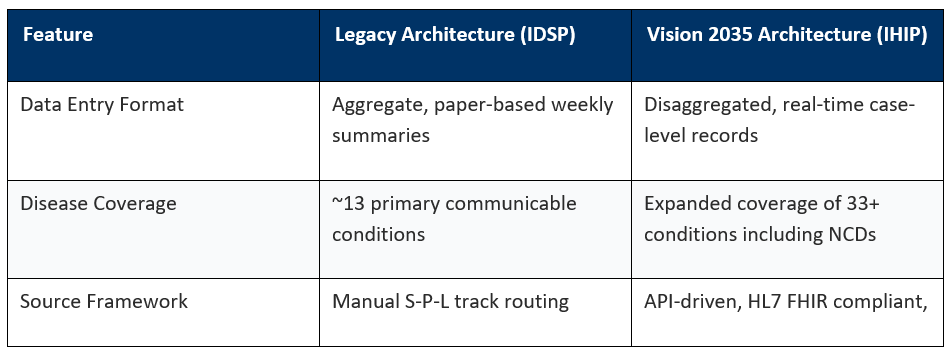
Historically, India relied heavily on the Integrated Disease Surveillance Programme (IDSP), established in 2004. While it successfully handled localized tracking, it was built primarily on separate paper-based reporting tracks:
Because these files rarely linked up automatically, and the program focused on only about 13 major communicable diseases, the full picture remained segmented. Vision 2035 shifts this framework entirely. Instead of just looking backward at historical data, the goal is real-time, action-oriented intelligence.
The backbone of this future system relies on a unified, digital ecosystem built directly into India’s evolving universal healthcare infrastructure.
While catching infectious outbreaks remains a priority, India is facing a massive epidemiological shift. Non-Communicable Diseases (NCDs) like cardiovascular ailments, diabetes, and cancers now account for an estimated 60% plus of all deaths in the country.
Vision 2035 moves beyond tracking temporary pathogens to monitoring lifestyle and environmental risk factors over generations. By utilizing predictive analytics, machine learning, and situation-aware signals—such as mobile sensor networks and participatory community monitoring—health authorities can predict NCD spikes in specific geographic pockets and strategically deploy preventive resources.
Transforming this vision into reality requires structural shifts: closing administrative vacancies at state and district monitoring units, formalizing strict data-sharing and privacy protocols, and scaling up advanced molecular diagnostic laboratories. Ultimately, Vision 2035 aims to turn public health surveillance into a proactive utility: using clean, unified data to safeguard communities well before a crisis ever reaches the hospital doors.
To look deeper into the government’s division handling these policy updates, you can explore the official NITI Aayog Health and Family Welfare Division page.
At Tecforz, we believe the future of medicine isn’t just about treating illness—it’s about stopping it before it starts. Whether you are a healthcare practitioner working on the front lines or a public health advocate shaping the community, partnering with us ensures you stay ahead of this critical shift in digital architecture.
Are you ready to build or integrate next-generation health systems? Explore how your clinical systems can align with the new national standards and lead the charge toward a predictive, data-secure tomorrow.